Story of a Hoodoo Ship
-
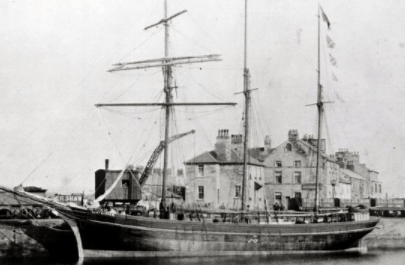
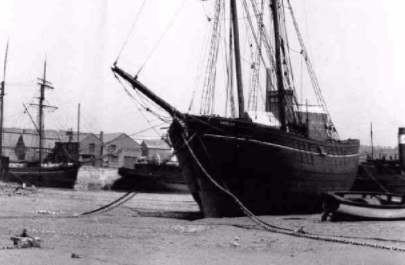
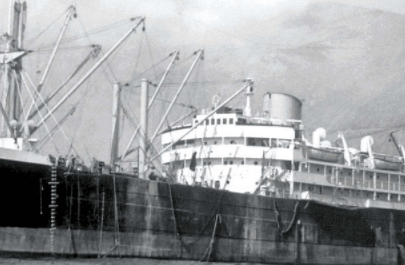 The names of the four sailors were R.Cochrane, John Johnson, Charles Walback, and H.Kimber. More than two years ago, in the early part of 1898, they came to this port in an English bark called the Blengfell, from Liverpool, and she had only been here two days when these four members of her crew left her on the ground that she was a " hoodoo ship." A month afterward she sailed homeward again, but she never reached port, for the evil fate that hung over her fulfilled its mission, and the battered remains of her big hulk have long lain many fathoms under the sea.
When Cochrane and his companions saw the name of their former ship written on the Erie Basin pier, their memories took a turn by no means pleasant. It seems that the ill-omened Blengfell's disastrous experiences began three voyages before the one that brought her to America, though it was on that trip that all hands aboard became convinced of a hoodoo's presence among them.
During a trip she took about three years before that time, a seaman went mad because of "visions" in his cabin at night. He drowned himself at last in despair. On the next voyage a negro sailor, who had been sick and in delirium, suddenly arose from his bed, grasped a brace of pistols, and ran all the rest of the crew aft, where he kept them at bay for twenty-four hours. Finally he threw down his pistols, uttered a wild shriek, and jumped headlong over the railing, disappearing immediately under the water and never rising to the surface again.
Whitehaven Sailing Ships
The Annan and Whitehaven Trader was a sloop. She was lost by collision with the Whitehaven to Liverpool steamer Queen, eleven miles SW of Peel, Isle of Man, on Saturday, 26th September 1857. The mate and the master's wife, Jane Irving, were drowned, the master and a seaman being saved. The sloop was salt laden so presumably had left the Mersey, and possibly was heading for Peel, a herring port still famous for its kippers. The wreck was towed into Fleetwood by a fisherman and Jane Irving's body was found therein. An inquest was held at Fleetwood and Jackson, the mate of the Queen, and Phillips, the seaman on look-out at the time of the collision, were sent for trial at Lancaster Assizes for manslaughter. The Cumberland Pacquet, a Whitehaven newspaper, presumably supporting the convicted seamen, who must have been Whitehaven men, produced a lengthy editorial condemning, and roundly abusing, the Fleetwood jury and their verdict.
Name: Annan and Whitehaven TraderYear Built: ?Gross Tons: 40Masts: 1
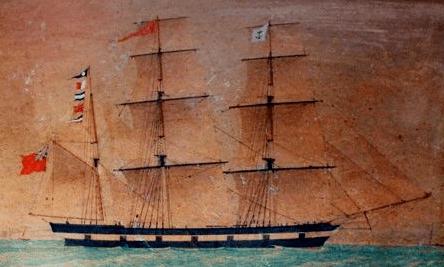 In 1866 the English barque Arequipa picked up two boats with part of the crew of the Severn, of London, that had sunk on the 15th June, and carried them into Pernambuco. A subsequent court case convicted four men, including the owners of the Severn and her mate, of attempting to defraud the vessel's insurers by deliberately scuttling her by boring holes in her hull. The owners of the Severn, Holdsworth and Berwick, were sentenced to 20 years imprisonment, the mate Webb to 10 years, and his accomplice to a lesser term (from the Times, see Source 8). The master of the Severn, Capt. Leyland, had been part of the conspiracy, but by informing and giving evidence had avoided prosecution.
Name: ArequipaYear Built: 1841Gross Tons: 257Length (feet): 98Breadth (feet): 24Depth (feet): 12Masts: 3
The Arachne was a full-rigged ship built by Thomas and Ralph Brocklebank at Bransty, Whitehaven. She was launched on the 30th August 1851 and was registered at Liverpool. Her first master was Capt.Alexander Adamson. The vessel's first voyage was to Calcutta, and she continued in this trade throughout her career, under a succession of masters (Capts. Roddock, King, Mawson, Sharp, Fletcher, Fearon, Francis Wise and John Kenworthy). The Arachne was abandoned in the Atlantic Ocean in November 1866. Bound from Calcutta, the ship was abandoned south of the Cape Verde Islands on 12th November, Capt.Kenworthy and all crew being saved.
Name: ArachneYear Built: 1851Gross Tons: 654Length (feet): 139.7Breadth (feet): 30.2Depth (feet): 21.1Masts: 3Figurehead: Woman
The Chrysolite was built at the Whitehaven shipyard of Shepherd & Leech in June 1869. She is described in Lloyds Register as a brigantine, but, like the Beckermet, had three-masts and was what would later become known as a barquentine. She was owned by G.Nelson & Co. of Whitehaven.
Name: ChrysoliteYear Built: 1869Net Tons: 159Length (feet): 95.6Breadth (feet): 21.6Depth (feet): 12.0Masts: 3
The Lion was a brig built at Whitehaven in 1770. The Lion was wrecked at Santon Head, Isle of Man on the 14th August 1827. She was bound from Barbrazan to Workington under the command of Capt. P.Dodgson. She struck the rocks near Port Iron and then foundered. All the crew were rescued, and the vessel's loss was valued at £1,300. At the time the vessel was registered at Workington and was owned by the master and others.
Name: LionYear Built: 1770Net Tons: 78
The Mary Isabella was a brig built by John Scott at Whitehaven and launched on the 21st February 1806. She foundered in severe weather off Silloth Bay in February 1835.
Name: Mary IsabellaYear Built: 1806Gross Tons: 144Masts: 2
The Wellington was a brig built by Thomas Cowen at Whitehaven and launched on the 6th June 1811. In 1832 her registry was transferred to Liverpool, and from 1845 to 1849 she was listed as a Bideford vessel, owned by Chanter & Co., master Capt.W.Day. The Wellington was a yellow-metalled vessel and Lloyds Register reports that she sailed in the North American trade from 1845 to 1847, and to Cape Breton in 1849.
Name: WellingtonYear Built: 1811Gross Tons: 225Masts: 2
The Woodville was a brig launched on the 24th June 1839 by John Scott at Whitehaven. Her master and principal owner in 1840 was Capt.I.C.Hellon, and the vessel was registered at Whitehaven. The Woodville was owned by her master, Capt. J.Purfield of Dublin, in 1894. She was on passage from Dublin to Liverpool with a wood cargo when she was stranded during a NW gale on the Great Burbo Bank, near the C6 red buoy, at the mouth of the river Mersey, on the 22nd December 1894. All five crew were drowned.
Name: WoodvilleYear Built: 1839Gross Tons: 167Masts: 2
The Watkins was a brig built at Whitehaven by John Scott, launched 3rd October 1834. In 1840 she was registered at Whitehaven and was owned by her master, Capt.John Whiteside. The Watkins, under the command of Capt.Varty, bound from Matanzas for Liverpool, was sunk by collision at 11 o'clock on the night of 5th April, 1848. She had left Cork that day and in thick fog, Tuskar bearing 18 miles N.E., collided with the Agnes, Capt.Smallman, bound from Dublin for New York with 222 passengers. The master and ten crew all perished in the wreck, but two, who managed to board the Agnes before the vessels parted after the collission, survived - Alexander Bowles (cooper) and Joseph Patterson (seaman).
Name: WatkinsYear Built: 1834Gross Tons: 236Masts: 2
The Wasdale was a full-rigged iron ship built in February 1872 by the Whitehaven Ship Building Company for the Dale Line. The Wasdale made a fast passage from Liverpool to Melbourne in 1875, leaving the Mersey on the 6th August, crossing the Line on 4th September and finally anchoring in Hobson's Bay on 20th October, a passage of 74 days. In 1876, under Capt. Baillie, she was prevented by weather from rounding Cape Horn and had to run east, making Australia via the Bass Straight in 136 days. The Wasdale was sunk by collision off Cape Horn in 1877, without loss of life. She was under the command of Capt.Chellew, 65 days out from Liverpool bound for San Francisco.
Name: WasdaleYear Built: 1872Gross Tons: 1284Length (feet): 227.7Breadth (feet): 36.3Depth (feet): 22.0Masts: 3
The Whitehaven Lass was a wooden barque built at Whitehaven by Hugh Williamson, launched 20th October 1860. She was registered at Whitehaven and owned by John Jackson, a local timber merchant who, in 1865, also owned the Victoria, Thomas, Martha and Hematite. The Whitehaven Lass was wrecked in a SW8 near gale at Parton, Cumberland on the 29th January 1883. She was carrying a cargo of iron ore from Spain to Workington, under the command of Capt. H.Greaves and with a crew of eight.
Name: Whitehaven LassYear Built: 1860Gross Tons: 262Length (feet): 110.5Breadth (feet): 24.6Depth (feet): 16.1Masts: 3
Despatch
Furness Sailing Ships