History of Sailing Ships
-
 Furness & Duddon Sailing Ships
The following list includes schooners, barquentines, brigs and other merchant sailing ships that were either built or owned in Barrow-in-Furness. -
 Whitehaven Sailing Ships
The following list includes schooners, barquentines, brigs and other merchant sailing ships that were built at Whitehaven. -
 Workington & Harrington Sailing ShipsThe following list includes schooners, barquentines, brigs and other merchant sailing ships that were built at Workington or Harrington.
 -
 Lancaster Sailing ShipsThe following list includes schooners, barquentines, brigs and other merchant sailing ships that were built at Glasson Dock, Lancaster.
 -
 Maryport Sailing ShipsThe following list includes schooners, barquentines, brigs and other merchant sailing ships that were built at Maryport.
 -
 Isle of Man Sailing ShipsThe following list includes schooners and other merchant sailing ships that were built in the Isle of Man.
 -
 Solway Sailing ShipsThe following list includes schooners, barquentines, brigs and other merchant sailing ships that were built or owned in the Scottish ports of the Solway Firt.
Dunboyne (af Chapman)
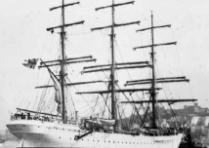
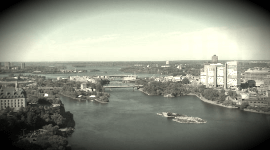
The Dunboyne was a full-rigged ship built at Whitehaven and launched in March 1888. Now renamed the af Chapman she is still afloat, and is reputedly the World's third oldest surviving iron-built ship (the Euterpe, built in the Isle of Man, is one of the older ships). The af Chapman is moored at Skeppsholmen in Stockholm, where she has been used as a youth hostel since1949, and has hosted over a million visitors.
Named the Dunboyne by her original Dublin owners, Charles E. Martin & Co., she participated in the trade to Australia in her early years. According to Tom Messenger (see Source 2), who was First Mate in 1890 on voyages between Wales and Australia, her master, Capt. O'Neill, had his wife and daughter aboard. Unfortunately the child died and was buried at sea.
Sold to Norway in 1909, the Dunboyne was renamed the G.D. Kennedy in July 1915 when she was bought by the Swedish shipping company Transatlantic. This company sold her to the Swedish government in 1924, and it was then that the ship was finally renamed af Chapman. She spent ten more years at sea, ending her final voyage on the 27th September 1934.
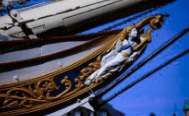
During World War II, the af Chapman was moored in Stockholm harbour, serving as a floating barracks for the Swedish Navy. No longer required by the Navy after the War, the ship was saved when the City of Stockholm bought her in 1947.
During World War II, the af Chapman was moored in Stockholm harbour, serving as a floating barracks for the Swedish Navy. No longer required by the Navy after the War, the ship was saved when the City of Stockholm bought her in 1947. The ship was to remain berthed in Stockholm harbour. She was renovated to serve as a youth hostel, and serves that purpose still today. Her modification preserved as far as possible the ship's original condition, the large open lower deck, for example, being divided with removeable bulkheads, to preserve the deck as it once would have looked.
| Name | Year Built | Gross Tons | Length (feet) | Breadth (feet) | Depth (feet) | Masts |
|---|---|---|---|---|---|---|
| Dunboyne | 1888 | 1355 | 256.9 | 37.4 | 18.3 | 3 |
Furness Sailing Ships